
Why Hood Latches Crack or Break on John Deere Compact Tractors
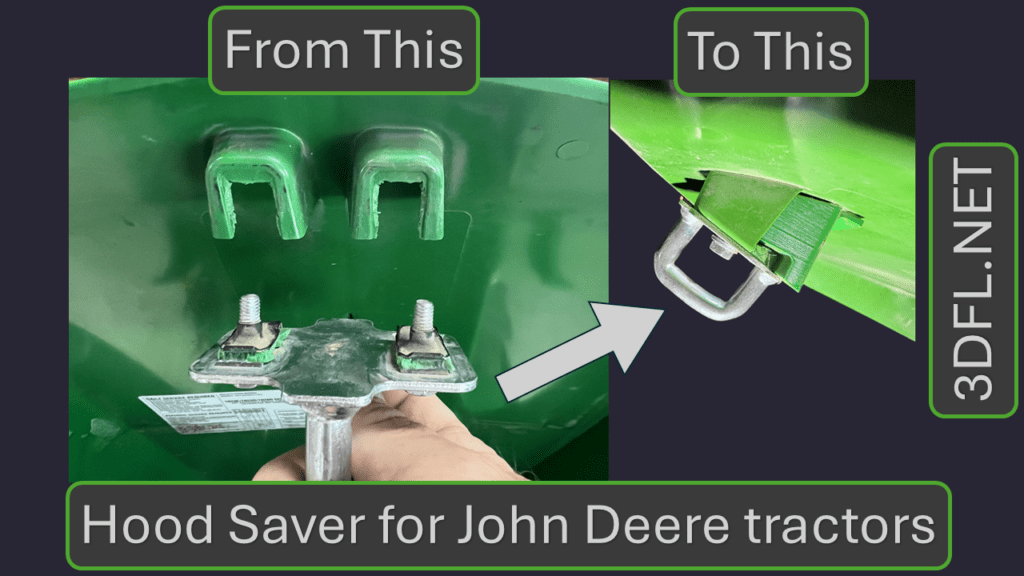
If you spend any time in compact tractor forums, you will see the same photo posted again and again: a cracked hood latch on a John Deere 1025R, 2025R, 2032R, or similar. Same crack pattern every time. Same starting point. This is not bad luck or rough use. It is a predictable failure mode in a plastic part working outside its design comfort zone.
Here is why it keeps happening.
The bracket does a job it was never sized for
The hood latch bracket is a thin plastic protrusion that carries the entire load of the hood every time you open and close it. It also resists the latch tension when the hood is closed and the tractor is running or moving. For a tractor that gets used once a month, that is fine. For a working tractor that gets opened daily, it is not.
Three things accelerate the failure
- Thermal cycling. The engine bay heats the plastic when the engine runs. Outside air cools it when the engine is off. Plastic expands and contracts at a different rate than the metal fasteners around it. Every cycle adds a little stress.
- UV exposure. If the tractor lives outside, sunlight breaks down the polymer chains in the plastic. UV-exposed plastic gets brittle faster than plastic in a barn or under cover.
- Cold brittleness. Cold plastic does not flex; it cracks. Most failures happen on cold mornings when an owner gives the hood a normal pull and the plastic does not have the give it had in July.
Where the crack starts
Almost always at the top of the mount where the cross-section is smallest and the bending moment is highest. The first crack is usually invisible from the top. You can find it by lifting the hood and looking sides of the hood latch mount. A hairline at the base is the early warning.
Why a new factory hood does not fix the problem
If you replace a cracked hood with a new one from the dealer, you have an identical hood latch in an identical engine bay being opened the same number of times. The new hood is on the same failure curve. It will crack on the same schedule unless something changes the load path. Some new hoods did come with reinforcing ribs, but they are still not effective.
What changes the load path
The Hood Saver reinforces the hood latch with a structural backing that spreads the load across a larger area. The high-stress concentration that started the original crack no longer concentrates in one spot. Force that used to live on a single thin plastic edge now distributes across a backing plate.
The full case for the Hood Saver and the install walkthrough are here:
If your hood latch is already cracked
You have two paths: replace the hood (expensive, and the new one is on the same curve), or repair plus reinforce with a Hood Saver. The five-year cost comparison favors the second path by a wide margin (see the breakdown).
Get a Hood Saver
Manufactured in the USA from globally sourced materials. Ships worldwide. Shop the Hood Saver.